

Table of Contents
- What Makes Billet Truck Parts Different
- Billet vs Cast Aluminum Parts: Which Holds Up Better
- Precision Engineering and Fitment You Actually Notice
- Custom Billet Interior Parts: Aesthetic and Structural Benefits
- Durability of Billet Steering Wheels and High-Stress Components
- The Real Cost: Daily Drivers vs Show Trucks
- Long-Term Maintenance and Why Anodized Finishes Matter
- Conclusion
Last Updated: August 24, 2026
What Makes Billet Truck Parts Different
Billet truck parts are precision-engineered components machined from solid aluminum blocks rather than cast or molded. The fundamental difference lies in the manufacturing process: while cast parts are poured into molds, billet components are cut, shaped, and refined using CNC machining equipment. This distinction matters because it determines how the material behaves under stress, how long it lasts, and what it actually looks like when installed.
The appeal is immediate. Billet aluminum parts deliver a show-quality finish straight from the machine, no porosity, no hidden voids, no weak points hiding inside the material. When you look at a billet door lock knob or steering column tilt lever, you're seeing material that was engineered to last, not material that was good enough to pass inspection.

At LG Billet USA, we focus on this exact problem: replacing brittle plastic components that deteriorate with precision-engineered billet alternatives. The factory used plastic because it was cheap and fast. Billet exists because truck enthusiasts demanded something that actually holds up.
The real advantage isn't just aesthetics, though that matters. It's structural integrity. Billet parts handle thermal cycling, the constant expansion and contraction from heat and cold, without cracking. They resist corrosion better than cast aluminum because the manufacturing process eliminates the microscopic defects where oxidation starts. For classic truck restoration and daily driver upgrades alike, this translates to components that outlast the vehicle itself.
Billet vs Cast Aluminum Parts: Which Holds Up Better
Cast aluminum parts are created by pouring molten metal into a mold and letting it cool. This process is fast and economical, which is why manufacturers use it for mass production. The problem: as metal cools unevenly inside a mold, microscopic voids and porosity develop throughout the material. These weak points are invisible to the eye, but they're structural liabilities.
Billet aluminum starts as a solid block. CNC machining removes material precisely, leaving behind a dense, homogeneous structure with no hidden defects (peer-reviewed research). There are no voids to trap moisture, no weak planes where cracks can propagate. The material itself is stronger because it's more uniform.
The durability difference shows up over time. Cast parts can develop stress fractures years after installation, especially in high-vibration areas like steering components. Billet parts resist this because the material has no weak points to initiate failure. For a daily driver exposed to road vibration and temperature swings, this matters. For a show truck that sits in a climate-controlled garage, the advantage is primarily aesthetic, though it's still real.
Corrosion resistance also favors billet. Cast aluminum's porosity creates pockets where water and salt can lodge, accelerating oxidation from the inside out. Billet's dense structure resists this penetration. When protected with an anodized finish, a controlled oxidation layer applied electrochemically, billet parts can resist corrosion for decades.
Cost is the trade-off. Billet components require more machine time and generate more scrap material, so they cost more to manufacture. Cast parts are cheaper, which is why you still see them everywhere. The question isn't whether billet is objectively superior, it is, but whether that superiority justifies the price for your specific application.
Precision Engineering and Fitment You Actually Notice
Precision engineering means the component is manufactured to tight tolerances, exact dimensions that ensure it fits correctly without modification. This matters more than most buyers realize.
When you order billet parts online, fitment anxiety is real. Will the door lock knob thread onto the factory rod correctly? Will the steering column tilt lever align with the existing mechanism? Will installation require drilling, grinding, or modification?
The answer depends on engineering. LG Billet USA designs components with OEM-like fitment, meaning they bolt on without modification. The door lock knobs use a 10-24 thread standard that matches factory specifications. The steering column tilt lever is engineered for 1967-1994 tilt column GM vehicles with threaded levers, it's not a universal approximation that requires trial-and-error fitting.
This precision comes from CNC machining. Unlike hand-fabricated or semi-manual processes, CNC machines repeat the same dimensions thousands of times with micron-level accuracy. Every component is identical to the last, so fitment is consistent. You don't get one that fits perfectly and another that requires adjustment.
The practical benefit: installation takes hours, not days. You don't need a machine shop or specialized tools. You don't need to modify the truck. This is why precision engineering matters to daily driver owners, it means the upgrade actually gets installed instead of sitting in the garage waiting for "someday."
For show trucks, precision engineering delivers a factory-quality appearance. No gaps, no misalignment, no visible compromises. The part looks like it belongs there because it was engineered to belong there.
Custom Billet Interior Parts: Aesthetic and Structural Benefits
Interior upgrades are where billet parts deliver the most visible transformation. Replacing brittle plastic components with precision-engineered billet alternatives changes how the truck feels and looks.
Factory hazard light knobs and door lock knobs were made from plastic because it was the cheapest option in 1970. After 50+ years, that plastic is cracked, missing, or brittle. The billet replacement isn't just an upgrade, it's a restoration that actually improves on the original.

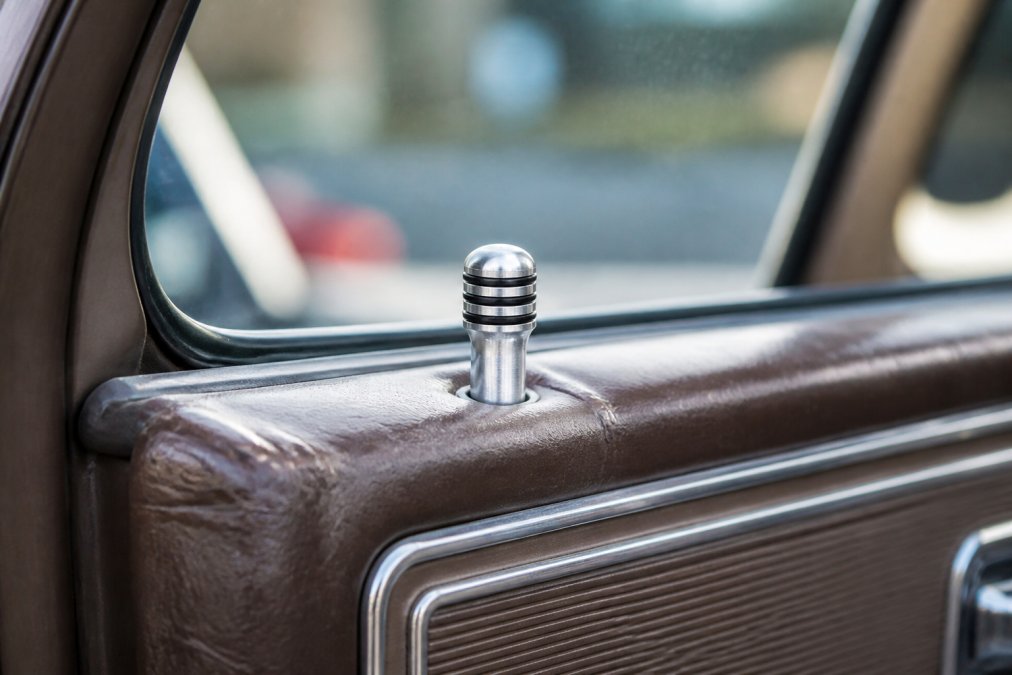
The aesthetic benefit is obvious. Billet components have a show-quality finish. They catch light differently than plastic or painted steel. They signal that this truck was restored with attention to detail. For classic truck owners, this matters because the interior is the first thing people see when they sit in the truck.
The structural benefit is less visible but equally real. Billet door lock knobs don't crack under hand pressure. Steering column tilt levers don't snap off when you adjust the column. These aren't decorative, they're functional components that actually work better than the originals.
Durability extends to thermal cycling. Plastic expands and contracts at a different rate than metal, creating stress at the connection points. Billet aluminum's thermal properties match the surrounding steel and aluminum components, so there's less stress concentration (peer-reviewed research). The part stays tight and doesn't develop play over time.
For daily drivers, this translates to controls that don't rattle, don't crack, and don't require replacement. For show trucks, it means components that stay pristine through multiple seasons of display. Either way, the investment pays dividends in reliability and appearance.
Durability of Billet Steering Wheels and High-Stress Components
Steering components experience constant stress. Every turn, every bump, every correction loads the steering column and its controls. Plastic can't handle this indefinitely, it fatigues, cracks, and fails.
Billet steering components are engineered for this environment. The material is strong enough to handle repetitive stress without degradation. The precision fit means loads distribute evenly across the component rather than concentrating at weak points.
For a daily driver, this means your steering controls remain functional and tight for the vehicle's lifetime. For a show truck, it means components that won't develop visible wear or damage.
The key is material science. Billet aluminum's strength-to-weight ratio is superior to plastic (peer-reviewed research). A billet steering column tilt lever is lighter than a steel equivalent but stronger than the original plastic. This matters for user experience, the control feels solid and responsive without adding unnecessary weight to the steering column.
Corrosion resistance is another durability factor. Steering components are exposed to moisture from the cabin and road spray. Billet aluminum, when anodized, resists this corrosion. The anodized finish, a controlled oxidation layer applied electrochemically, creates a barrier that protects the underlying aluminum. This finish can last decades with minimal maintenance.
Compare this to cast aluminum steering components, which can develop corrosion from internal porosity. Water penetrates the microscopic voids and oxidizes the material from inside, weakening the component invisibly until failure occurs. Billet's dense structure prevents this.
The Real Cost: Daily Drivers vs Show Trucks
The value proposition for billet parts depends on your truck's role. For a show truck, billet upgrades are an investment in appearance and longevity. For a daily driver, the calculation is different.
Show trucks justify billet parts because they're on display. Every component is visible and contributes to the overall impression. A pristine interior with precision-engineered billet upgrades signals serious restoration. The cost is part of the investment in the truck's value and presentation.
Daily drivers have different priorities. Reliability and function matter more than show-quality finishes. For a daily driver, billet parts make sense where they improve durability or replace failed components. A billet hazard light knob replaces a missing or broken factory part, that's a clear value proposition. A billet door lock knob is an upgrade that improves the interior feel and eliminates future failure points.
The cost-benefit analysis: billet parts typically cost more upfront than cast or plastic alternatives. A pair of billet door lock knobs from LG Billet USA runs $25, while generic cast or plastic options might cost less. But the billet version will outlast multiple replacements of cheaper alternatives. For a truck you plan to keep long-term, this math favors billet.
For daily drivers, prioritize billet upgrades in high-wear areas: steering components, door mechanisms, and interior controls that get frequent use. These are where durability delivers tangible benefits. Cosmetic-only upgrades can wait or be skipped if budget is tight.
For show trucks, billet upgrades are justified across the interior. The goal is consistency and quality, and billet delivers both. The investment in appearance and durability supports the truck's value and presentation.
Free shipping on billet parts through LG Billet USA eliminates a cost factor that typically adds 8-15% to online purchases. This shifts the value equation, you're paying for the component and engineering, not for shipping premium.
Long-Term Maintenance and Why Anodized Finishes Matter
Billet aluminum's long-term durability depends on surface protection. The anodized finish is the critical factor that separates components that look pristine for decades from those that oxidize and deteriorate.
Anodizing is an electrochemical process that creates a controlled oxide layer on the aluminum surface. This layer is harder than the underlying aluminum, resistant to corrosion, and available in various colors. Unlike paint, which can chip or peel, anodized finishes are integral to the material, they can't separate or flake off.
The anodized layer blocks moisture and oxygen from reaching the underlying aluminum, preventing the oxidation that causes corrosion. For billet parts exposed to road salt, humidity, or temperature cycling, this protection is essential. An anodized billet component can resist corrosion for 20+ years with minimal maintenance.
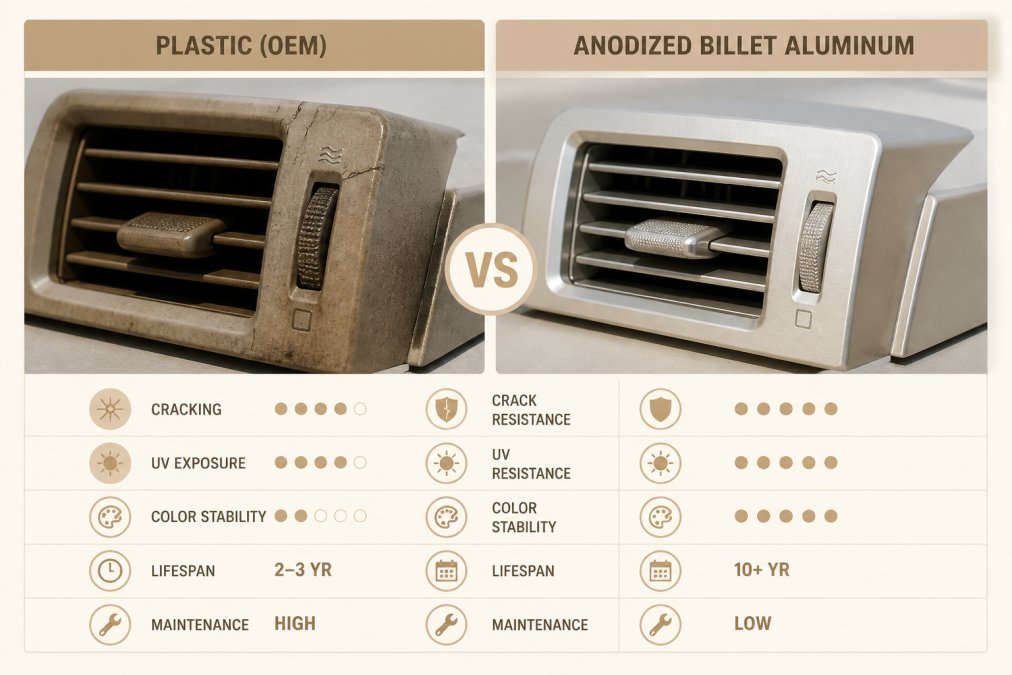
Maintenance is straightforward. Anodized billet parts require occasional cleaning with mild soap and water. No special products, no protective coatings, no complex procedures. The anodized finish handles the protection, your job is just keeping it clean.
For show trucks stored indoors, maintenance is minimal. The controlled environment protects the anodized finish, and occasional dusting keeps the component looking pristine. For daily drivers exposed to weather, the anodized finish still delivers decades of protection. Road salt and moisture won't penetrate the oxide layer.
The alternative, bare billet or powder-coated finishes, requires more maintenance. Bare billet oxidizes over time, developing a gray patina that some owners like but others don't. Powder coating can chip under impact or at installation points. Anodized finishes avoid both issues.
When evaluating billet parts, confirm that components are anodized. This single factor determines whether your upgrade will look pristine in five years or show visible oxidation. LG Billet USA's billet components are anodized, providing long-term corrosion resistance without ongoing maintenance burden.
Cost-wise, anodizing adds to the manufacturing expense, which is why cheaper billet alternatives sometimes skip it. Don't. The anodized finish is what separates a lasting upgrade from a component that requires refinishing in a few years.
Conclusion
Billet truck parts deliver measurable value where it matters: durability, precision fit, and long-term reliability. For classic truck restoration, they replace failed plastic components with precision-engineered alternatives that actually improve on the original design. For daily drivers, they eliminate future failure points and improve the interior feel. For show trucks, they deliver the show-quality finish and consistency that serious restoration demands.
The investment makes sense if you plan to keep the truck long-term and value durability over the lowest upfront cost. LG Billet USA specializes in precision-engineered billet components for classic and modern trucks, with free shipping on all orders and OEM-like fitment that ensures installation without modification. Explore their selection of 3 Band Billet Aluminum Door Lock Knobs, OE Style Billet Aluminum Door Lock Knobs, Chevy | GMC 1967-1994 C10/K10 Billet Hazard Light Knob, and Chevy | GMC Billet Steering Column Tilt Lever 1967-1994 to find the components that match your truck and your vision.

Frequently Asked Questions
Q: Are billet truck parts actually made in the USA, or is that just marketing?
A: LG Billet USA manufactures, assembles, and packages billet parts in the USA using 6061-T6 billet aluminum stock. Each part goes through CNC machining and precision engineering to achieve OEM-like fitment. You can verify domestic manufacturing by checking product descriptions, genuine domestic producers list machining location and materials transparently. This matters because domestic production means shorter lead times, easier returns, and quality control oversight.
Q: Will billet truck parts actually fit my truck without modification, or will I need a shop visit?
A: Quality billet parts from reputable manufacturers are engineered for OEM-like fitment, meaning bolt-on installation without modification. LG Billet USA designs parts to fit specific truck models (1967-1994 Chevy/GMC) with precision engineering. Verify compatibility by checking product specifications for your exact year and model. If a part lists your truck model, fitment should be direct. If unsure, contact the manufacturer before purchasing.
Q: How long do billet truck parts actually last compared to plastic factory parts?
A: Billet aluminum components outlast plastic factory parts by decades. Plastic deteriorates from UV exposure, temperature cycling, and brittleness over time, factory hazard knobs and tilt levers commonly crack within 15-20 years. Anodized billet aluminum resists corrosion and maintains structural integrity for the life of your truck. The trade-off: billet costs more upfront but eliminates replacement cycles and maintains value in restorations.
Q: Is the free shipping from LG Billet USA built into higher prices, or is it a real deal?
A: Free shipping is a genuine value when you compare total cost to competitors charging shipping separately. LG Billet USA's pricing on door lock knobs ($25) and steering column tilt levers ($35) is competitive with industry standard pricing before shipping is added. The free shipping advantage becomes more obvious on larger orders, a $200+ parts purchase saves $20-40 in shipping fees versus other retailers.
This article was written using GrandRanker