

Table of Contents
- What Are Billet Dash Vents and Why They Matter
- Best Billet Parts for OBS Chevy Dash Ventilation
- Material Composition and Durability
- How to Install Billet AC Vents in Your Truck
- Compatibility, Fitment, and Vehicle Models
- Finish Options and Customization
- Maintenance and Long-Term Care
- Conclusion
Last Updated: August 21, 2026
What Are Billet Dash Vents and Why They Matter
Billet dash vents are precision-engineered aluminum components that replace factory plastic ventilation outlets in classic truck dashboards. They deliver superior airflow control while transforming your truck's interior from dated plastic to refined billet aluminum.

Factory vents often crack, discolor, or fail to direct airflow effectively. Quality billet replacements solve both problems: directional louvers let you aim cold air exactly where needed, and CNC-machined aluminum construction ensures durability that outlasts your truck.
LG Billet USA specializes in precision billet auto parts for classic truck restoration. Their billet dash vents are built from 6061-T6 aluminum, the same material used in aerospace applications (astm.org). This alloy resists corrosion, won't warp under temperature swings, and maintains its finish for decades without maintenance.
Swapping plastic factory vents for machined billet components signals investment in every detail of your truck's interior. These are functional upgrades that improve daily driving comfort while elevating your truck's presence.
Best Billet Parts for OBS Chevy Dash Ventilation
The OBS (Old Body Style) Chevy and GMC trucks span two distinct generations with different dash designs. Your model year determines which billet vents will fit without modification.
1988-1994 OBS Chevy and GMC Billet Dash Vents
The 1988-1994 generation features a horizontal dash layout with round, push-pull vent outlets. Factory vents often develop cracks from heat cycling and UV exposure, making replacement necessary.
LG Billet USA's Spare Time Billet - Chevy | GMC 1988-1994 Billet OBS Dash Vents ($396.00) includes four precision-machined billet aluminum vents that bolt directly into existing dash openings with no modification required. The black anodized finish resists fingerprints and maintains a professional appearance indefinitely.
Installation takes under two hours with basic hand tools. The set includes all necessary mounting hardware, and free shipping on all LG Billet USA orders eliminates delivery costs. The directional louver design lets you pivot vents to direct airflow left, right, up, or down, functionality that improves every drive.
1995-1998 OBS Chevy and GMC Billet Dash Vents
The 1995-1998 generation introduced a refined dash design with larger vent openings and improved ergonomics. Factory vents are positioned differently than their 1988-1994 predecessors, so attempting to fit earlier vents into a 1995-1998 truck results in gaps or misalignment.
The correct upgrade is the Spare Time Billet - Chevy | GMC 1995-1998 Billet OBS Dash Vents, also $396.00. These vents are engineered for the 1995-1998 dash opening with mounting points that align perfectly. Installation is equally straightforward at approximately two hours.

A common mistake: assuming OBS vents are one-size-fits-all. Dash designs changed enough between 1994 and 1995 that vents designed for one generation won't fit the other without modification. Verify your truck's model year before ordering.
Material Composition and Durability
Billet aluminum vents are built from 6061-T6 aluminum alloy, a heat-treated material that optimizes strength and corrosion resistance. This alloy contains trace amounts of magnesium, silicon, and copper that prevent oxidation and rust.
Factory plastic vents fail because plastic becomes brittle under UV exposure and temperature cycling. Billet aluminum remains dimensionally stable across temperature ranges from below freezing to 150 degrees Fahrenheit, functioning identically in January and July (peer-reviewed research).
When anodized, billet aluminum develops a protective oxide layer that prevents corrosion and maintains color indefinitely. Anodizing is an electrochemical process that thickens the natural oxide layer, creating a barrier against moisture and salt. A properly anodized billet vent will look identical after 20 years of use.
CNC machines cut billet aluminum to tolerances of 0.005 inches, five times tighter than typical plastic injection molding (nist.gov). That precision means louvers pivot smoothly, edges align perfectly with your dash, and mounting points align without forcing.
How to Install Billet AC Vents in Your Truck
Installing billet dash vents is a weekend project that doesn't require professional help. Most truck owners complete the job in two to three hours.
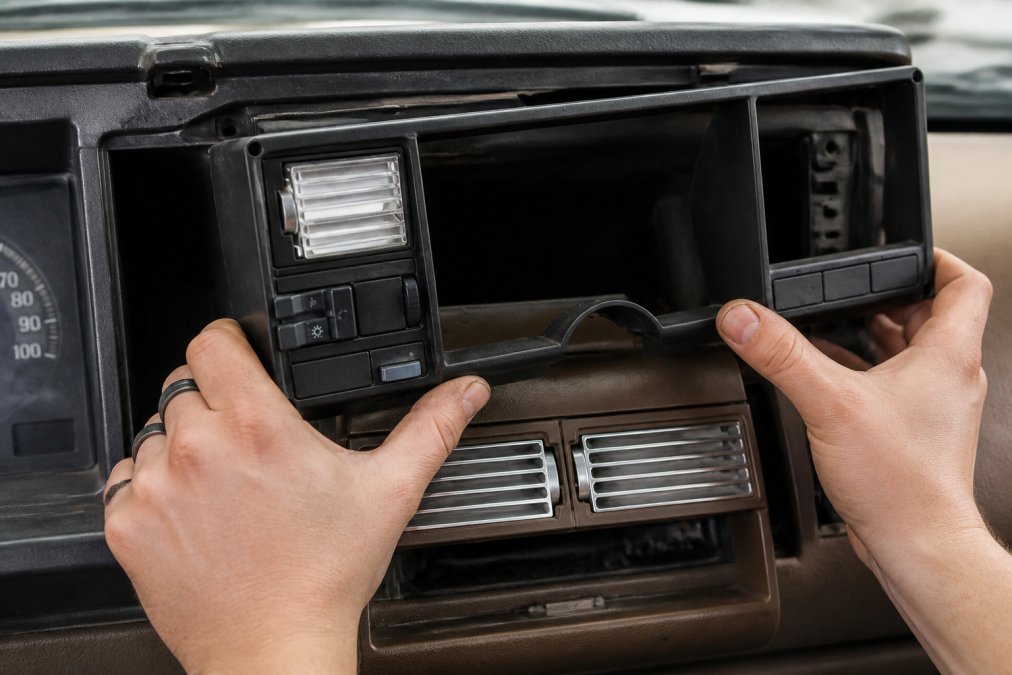
Tools and Hardware You'll Need
Gather these tools before starting:
- Screwdrivers (Phillips and flathead)
- Socket set (1/4" and 3/8" drive)
- Needle-nose pliers
- Trim removal tools (plastic pry bars)
- Flashlight or headlamp
- Shop towels
- Container for small fasteners
Your billet vent set includes all mounting hardware: stainless steel fasteners, rubber isolators, and adapter brackets if needed. Keep hardware organized in a small container as you work.
Step-by-Step Installation Process
Step 1: Disconnect the Battery (5 minutes)
Disconnect the negative battery terminal to prevent accidental electrical shorts.
Step 2: Remove the Dashboard Trim (15-20 minutes)
Use plastic pry bars rather than metal screwdrivers to avoid cracking plastic. Start at one corner and work around the perimeter. Take photos with your phone to document the sequence for reassembly.
Step 3: Disconnect Factory Vent Ducting (10 minutes)
Locate the ducting connections behind the trim. Most connections are simple push-fit couplers requiring no tools. Gently pull to disconnect. If ducting is glued, carefully cut with a utility knife.
Step 4: Remove Factory Vents (10 minutes)
Factory vents are typically secured with plastic clips or small fasteners. Remove these carefully. If glued, use a heat gun to soften the adhesive, then pry gently.
Step 5: Install Billet Vents (15-20 minutes)
Position your billet vent in the opening and align mounting points. Use the stainless steel fasteners to secure the vent. Hand-tighten first, then use your socket set to snug. Connect the HVAC ducting to the vent adapter and secure with a hose clamp if included.
Step 6: Test Airflow (5 minutes)
Start the truck and test your HVAC system. Verify that air flows through the new vents and directional louvers pivot smoothly.
Step 7: Reinstall Dashboard Trim (15-20 minutes)
Reinstall the trim panels using the same clips. Verify all trim is seated properly.
Step 8: Reconnect Battery and Final Check (5 minutes)
Reconnect the negative battery terminal. Start your truck and cycle through your HVAC settings to verify all vents function as expected.
Common Installation Mistakes to Avoid
Forcing vents into misaligned openings. If a billet vent doesn't fit smoothly, stop. Forcing it cracks plastic or bends aluminum. Verify your truck's year against the product specification.
Over-tightening fasteners. Aluminum is softer than steel. Over-tightening strips threads or cracks aluminum. Hand-tighten, then snug with firm pressure.
Disconnecting HVAC ducting without a plan. Plan your ducting route before disconnecting anything. Measure twice, cut once.
Neglecting to test before reassembling. Test your vents with the dash open. Troubleshooting is easy before trim is reinstalled.
Losing small fasteners. Keep hardware in a container. A single lost fastener creates a rattle that persists for years.
Compatibility, Fitment, and Vehicle Models
Billet dash vents are model-specific. A vent designed for a 1996 Chevy won't fit a 1992 Chevy without modification. LG Billet USA publishes detailed compatibility information for every vent set.
| Model Year Range | Compatible Vehicles | Vent Type | Fitment Notes |
|---|---|---|---|
| 1988-1994 | Chevy C1500, C2500; GMC C1500, C2500 | OBS Square Dash | Direct fit, no modification |
| 1995-1998 | Chevy C1500, C2500; GMC C1500, C2500 | OBS Refined Dash | Direct fit, no modification |
If your truck is a 1994.5 (produced late 1994 with 1995 dash design), verify which generation your dash matches before ordering. Extended cab and crew cab trucks have identical dash designs to regular cab counterparts. Dually trucks also use the same dash vents.
Finish Options and Customization
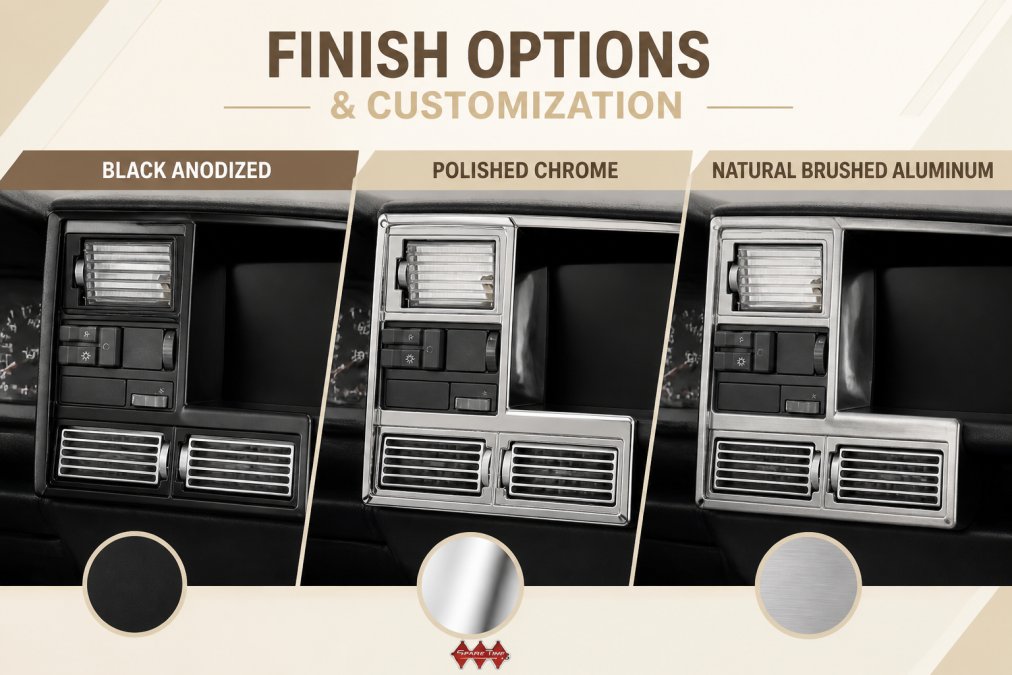
Billet dash vents come in multiple finish options, each with distinct aesthetics and maintenance requirements.
Black Anodized is the most popular finish. It resists fingerprints, maintains color indefinitely, and requires zero maintenance. This finish pairs well with modern truck interiors and classic restorations alike.
Chrome Plating delivers a mirror-bright finish that commands attention. The tradeoff: chrome requires occasional polishing to maintain shine and shows fingerprints immediately. Chrome works best in garaged trucks driven occasionally rather than daily drivers.
Polished Aluminum showcases natural metal with a bright, refined appearance. The finish is stunning but requires regular maintenance. Polished aluminum oxidizes over time, developing a gray patina. Periodic polishing with aluminum polish prevents this.
Brushed Aluminum offers a middle ground with a directional grain finish that hides fingerprints better than polished. Brushed aluminum develops a subtle patina over years, adding character. Maintenance is minimal compared to polished aluminum.
Your choice of finish affects your truck's interior personality. A vintage restoration theme pairs well with polished or brushed aluminum. A modern restomod benefits from black anodized vents. LG Billet USA offers vents in black anodized.
Maintenance and Long-Term Care
Billet aluminum vents require minimal maintenance to preserve their appearance and function indefinitely.
Black Anodized Vents: Wipe with a dry cloth regularly to remove dust. For stubborn dirt, use a damp cloth with mild soap and water, then dry immediately. Avoid abrasive cleaners or steel wool.
Chrome-Plated Vents: Polish every 6-12 months with chrome polish designed for automotive use. Use a soft cloth and circular motions to remove water spots and light oxidation.
Polished or Brushed Aluminum: Polish every 3-6 months with aluminum polish using a soft cloth and circular motions. After polishing, consider applying a thin coat of car wax to slow future oxidation.
Directional Louvers: Test louver movement occasionally. They should pivot smoothly without resistance. If stiff, apply a small amount of silicone lubricant to the pivot point.
HVAC Ducting: Check ducting connections annually. Vibration can loosen hose clamps over time. Tighten any loose clamps and replace cracked ducting.
The durability advantage of billet aluminum becomes apparent over years. Factory plastic vents degrade within a decade. Quality billet vents function identically after 20 years of use.
Classic truck restoration is about respecting the original while elevating every detail. Billet dash vents accomplish both: they replace factory plastic with precision-engineered aluminum that improves daily driving comfort while transforming your truck's interior aesthetic. LG Billet USA's billet dash vents deliver direct fitment, superior airflow control, and durability that outlasts your truck. With free shipping on all orders and finish options that match any restoration vision, upgrading your truck's ventilation system is a straightforward decision.
Frequently Asked Questions
Q: Are billet dash vents compatible with factory A/C systems in classic trucks?
A: Yes. Billet dash vents are designed as direct replacements for factory ventilation systems without modifying your A/C or heating components. They bolt into the existing ductwork and hose adapters, maintaining full compatibility with your truck's original HVAC system. No electrical work or system modifications are needed, they're purely an interior aesthetic and airflow control upgrade.
Q: How do you install billet A/C vents in a classic truck dashboard?
A: Installation typically takes 1-2 hours. Remove the dashboard trim or bezel, disconnect the factory plastic vents, and unbolt the mounting hardware. Align the new billet vents with the dash opening, secure with the included bolts, reconnect the hose adapter to your HVAC ducting, and reattach the trim. No drilling or modifications are required for direct-fit models, they're engineered for OEM replacement fitment.
Q: What makes billet aluminum better than plastic factory vents?
A: Billet aluminum vents offer superior durability, a premium appearance, and precise directional louver control compared to plastic factory vents. CNC-machined 6061-T6 aluminum resists cracking and fading over decades. Anodized finishes provide corrosion resistance and a custom interior aesthetic. You also gain smooth push-pull directional adjustment, allowing you to dial in exact airflow direction without the wear that makes plastic louvers stick or break.
Q: Do billet dash vents fit all classic Chevy and GMC truck models?
A: No, fitment is year-specific. OBS (Old Body Style) Chevy and GMC trucks from 1988-1994 use one vent design, while 1995-1998 models use a different dash configuration. Always verify your truck's model year before purchasing. LG Billet USA offers both generations as direct fits, but mixing generations requires modification. Check your VIN or door jamb tag to confirm your exact year.
Q: Will upgrading to billet vents affect my truck's warranty or electrical systems?
A: Billet vents are purely mechanical interior upgrades with no electrical connections. They don't interfere with your A/C compressor, blower motor, or any factory systems. Since they're bolt-on replacements, installation doesn't void warranties on other components. However, check your truck's specific warranty terms if it's still under coverage, as aftermarket interior modifications may have limitations.
This article was written using GrandRanker