

Table of Contents
- Billet vs Plastic: What Each Material Actually Is
- How Billet Aluminum Is Made
- How Factory Plastic Interior Parts Are Produced
- Durability, Heat, and Long-Term Wear: Billet vs Plastic
- Weight, Fitment, and Installation Complexity
- Aesthetic Appeal and Customization Options
- Painting Interior Plastic Parts: Restoration and Refresh
- How to Clean Billet Aluminum Interior Parts
- Which Upgrade Is Right for Your Truck?
- Conclusion
Last Updated: August 15, 2026
Billet vs Plastic: What Each Material Actually Is
The debate over billet vs plastic truck interior parts comes down to more than aesthetics. Both materials serve legitimate purposes, but they perform very differently under real-world conditions.
Billet aluminum is a solid, precision-machined material produced by cutting components from a single block of aluminum stock. In the automotive world, billet parts are almost always machined from 6061-T6 aircraft-grade aluminum, known for its high strength-to-weight ratio, corrosion resistance, and excellent surface finish characteristics.
Factory plastic interior parts are produced through injection molding, a high-volume manufacturing process where molten polymer is injected into a mold cavity under pressure. The polymers used vary by application, soft-touch materials like thermoplastic elastomers are common on surfaces that contact skin, while hard ABS plastic dominates structural trim pieces.
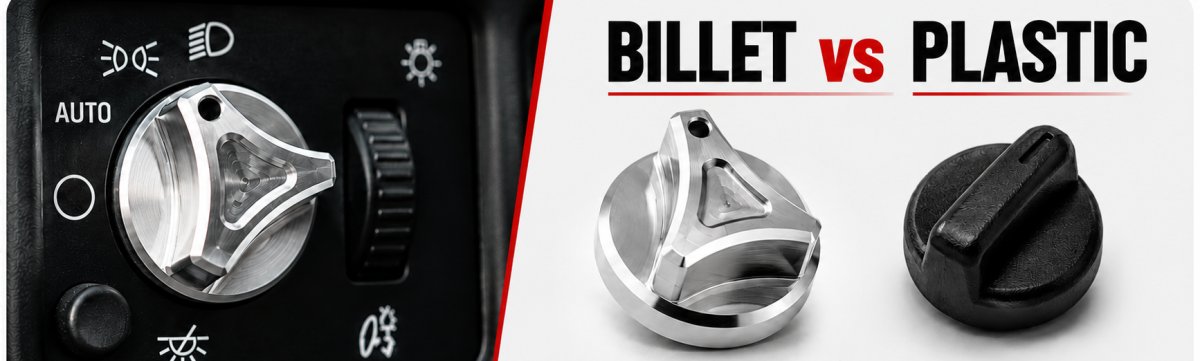
Close-up side-by-side of a polished billet aluminum dash knob and a factory black plastic knob resting on a truck dashboard, showing the contrast in surface finish and material quality
How Billet Aluminum Is Made
Billet aluminum components start as solid billets loaded into CNC machining centers. Computer-controlled cutting tools remove material with extreme precision, producing parts with tight dimensional tolerances and consistent structural integrity. Many billet parts receive additional finishing treatments, including polishing, anodizing, or brushing, which enhance corrosion resistance and aesthetic appeal. The CNC machining process ensures each part is geometrically identical to the next, a significant advantage for truck owners worried about fitment.
How Factory Plastic Interior Parts Are Produced
Injection molding is fast and cost-effective at scale, which is why every major automaker uses it for dashboard components, trim panels, door handles, and interior knobs. The trade-off for low manufacturing cost is real: plastic is susceptible to UV degradation, surface cracking, and material fatigue over time, especially in truck cabs that experience significant heat cycling.
Durability, Heat, and Long-Term Wear: Billet vs Plastic
Aluminum wins this category outright. Billet aluminum components do not crack, warp, or degrade from UV exposure. Plastic is vulnerable to all three failure modes, anyone who has owned an older OBS Chevy or GMC knows exactly what this looks like: brittle dash knobs that snap under normal torque, faded trim panels, and door handles that crumble in cold weather.
Thermal stability is a meaningful differentiator. Aluminum maintains its structural integrity across the temperature ranges a truck interior experiences, from cold winter mornings to cabs baking in summer heat. Plastic can deform or become sticky at elevated temperatures, and UV degradation accelerates the breakdown of polymer chains over time.
According to the ASM International materials reference on aluminum alloys, 6061-T6 aluminum maintains its mechanical properties across a broad temperature range, making it well-suited for automotive applications where thermal cycling is constant.
Impact resistance also favors billet. A dropped billet knob bounces; a dropped plastic knob from a 30-year-old truck often doesn't survive the fall. For daily drivers and working trucks, component longevity matters more than the initial price difference.
Property |
Billet Aluminum |
Factory Plastic |
|---|---|---|
UV Degradation |
None |
High risk over time |
Thermal Stability |
Excellent |
Moderate to poor |
Impact Resistance |
High |
Varies by polymer |
Surface Finish Durability |
Excellent |
Fades and scratches |
Expected Lifespan |
Decades |
10-20 years typical |
Corrosion Resistance |
High (anodized) |
N/A |
Weight, Fitment, and Installation Complexity
Billet aluminum is denser than plastic, so individual billet interior parts are heavier than their plastic counterparts. For a single knob or trim piece, the weight difference is negligible. If you replace every interior trim component on a truck with billet, the cumulative weight addition is still modest compared to any meaningful suspension or drivetrain modification.
Fitment is where billet parts earn their reputation. High-quality billet components machined to OEM specifications install as direct replacements without drilling, cutting, or modification. A common frustration among truck owners is purchasing parts that look correct in photos but require significant modification to fit properly. The solution is sourcing billet parts specifically engineered for your vehicle's year and model.
For electrical components like switch bezels or gauge pod surrounds, installation complexity depends entirely on the part design. Well-designed billet interior accessories replace only the visual trim, leaving the underlying wiring harness and electrical systems completely untouched.
Aesthetic Appeal and Customization Options
Factory plastic interior trim has a utilitarian look that reads as worn and dated decades later. Billet aluminum transforms the same surface into something that looks intentional and custom, even on a stock build.
Interior shot of a classic OBS Chevy truck cab with polished billet aluminum trim pieces installed on the dashboard and center console, showing a clean custom look under warm lighting
The customization options for billet interior parts are broad. Polished finishes deliver a mirror-like appearance that reflects light and creates visual contrast. Brushed finishes offer a more understated, industrial look. Anodized finishes in black or colored variants allow for coordinated interior color schemes. Some manufacturers offer CNC-machined patterns on knobs and trim pieces, adding tactile feedback and visual texture that factory plastic cannot replicate.
For OBS Chevy and GMC trucks specifically, available billet interior accessories cover dashboard knobs, shift handles, door lock posts, dash panel trim, and steering wheel components. The cumulative effect is a cabin that looks cohesively upgraded rather than pieced together.
According to SEMA's aftermarket industry report, interior customization remains one of the fastest-growing segments of the truck accessory market, driven by owners seeking to personalize their cab environments.
Painting Interior Plastic Parts: Restoration and Refresh
Painting interior plastic parts is a legitimate restoration strategy for truck owners who want to refresh faded trim without replacing every piece. The core challenge is adhesion, plastic surfaces are non-porous and often have mold-release residue from manufacturing. Paint applied directly to unprepared plastic will peel, chip, or flake under normal use.
Proper preparation involves cleaning the surface thoroughly, scuffing with fine-grit sandpaper to create mechanical adhesion, and applying a plastic-specific adhesion promoter before any paint or primer. For hard plastic trim, lacquer paint in rattle-can form works for small pieces. Vinyl dye is better for flexible plastic components because it chemically bonds with the plastic polymer, making it significantly more resistant to wear.
For a full interior plastic restoration, the sequence is:
- Remove the trim piece from the vehicle
- Clean with isopropyl alcohol to remove oils and residue
- Scuff the surface lightly with 400-grit sandpaper
- Apply plastic adhesion promoter and allow to dry fully
- Apply thin coats of vinyl dye or lacquer paint, allowing each coat to dry
- Finish with a clear coat rated for interior plastics
- Reinstall after full cure, typically 24-48 hours
Painting extends the life of plastic trim significantly, but does not address underlying material fatigue or brittleness that develops in aged plastic.
How to Clean Billet Aluminum Interior Parts
Billet aluminum is significantly easier to maintain than plastic, which absorbs grime and stains into its surface texture over time. For routine cleaning, a microfiber cloth dampened with mild soap and water is sufficient for most billet aluminum interior parts. Avoid abrasive cleaners or steel wool, which will scratch polished finishes.
For polished billet components that have developed oxidation or light tarnish, aluminum-specific metal polish restores the surface finish effectively. Apply a small amount to a clean microfiber cloth, work in circular motions, and buff to a clear finish.
Anodized billet parts require the gentlest approach. The anodized layer provides color and corrosion resistance but can be damaged by harsh chemicals or abrasive compounds. Stick to mild soap, water, and a soft cloth for anodized components.
The interior environment of a truck cab concentrates oils from hands, sunscreen, and cleaning products onto frequently touched surfaces. Billet knobs and shifter handles benefit from a quick wipe-down every few weeks, which prevents buildup from becoming a more involved cleaning project.
Which Upgrade Is Right for Your Truck?
The right choice between billet and plastic depends on what you are trying to accomplish.
If your truck's interior plastic is structurally sound and you are primarily dealing with cosmetic fading, painting and restoring the existing plastic is a cost-effective first step. If you want a permanent, high-quality interior upgrade that improves both aesthetics and tactile feel, billet aluminum is the correct answer. The parts last longer, look better over time, and require less ongoing maintenance.
The practical decision framework:
- Restore with paint: Plastic is intact, budget is limited, cosmetic refresh is the goal
- Replace with billet: Plastic is brittle or broken, long-term durability matters, visual upgrade is the priority
- Combine both: Replace high-contact pieces like knobs and shifter handles with billet; restore lower-touch panels with paint
LG Billet USA carries a comprehensive range of billet interior parts engineered specifically for Chevy, GMC, Ford, Dodge, Toyota, and Jeep trucks, with free shipping on every order. The parts are precision-machined for direct fitment, which addresses the most common frustration truck owners have with aftermarket billet: parts that look right but require modification to install.
Choosing between billet and plastic truck interior parts is ultimately a question of what you want your truck to be. Factory plastic was engineered for cost-efficiency at scale, not for the enthusiast who wants a cab that reflects the same attention to detail as the rest of the build. LG Billet USA specializes in precision-machined billet interior components with wide vehicle compatibility across Chevy, GMC, Ford, Dodge, Toyota, and Jeep, backed by free shipping on every order. Browse the full catalog at LG Billet USA and find the parts engineered for your specific year and model.
Frequently Asked Questions
What are the main advantages of billet aluminum interior parts over factory plastic?
Billet aluminum interior parts offer significantly better corrosion resistance, impact resistance, and long-term durability compared to factory plastic. They won't crack, warp, or suffer UV degradation the way hard plastic and soft-touch materials do over time. Billet parts are CNC-machined from aircraft-grade 6061 aluminum, giving them a precise surface finish and a premium tactile feel that factory injection-molded plastic simply can't match. They also hold up better under heat cycles, making them a practical upgrade for daily drivers and show trucks alike.
Are billet interior parts compatible with all truck models?
Most billet interior accessories are designed as direct-replacement parts for specific vehicle makes and model years, including OBS and NBS Chevy and GMC trucks, Ford, Dodge, Toyota, and Jeep. Fitment is model-specific, so always verify compatibility before ordering. Quality suppliers list exact fitment data by year, make, and model. When parts are precision-machined to OEM specifications, they bolt up without drilling or cutting, which eliminates the guesswork that comes with generic aftermarket pieces.
How does painting interior plastic parts compare to replacing them with billet?
Painting interior plastic parts using vinyl dye or lacquer paint is a cost-effective way to refresh faded or discolored trim without replacing it. It works best on hard plastic and vinyl surfaces that are structurally sound but cosmetically worn. However, painted plastic remains vulnerable to UV degradation, chipping, and material fatigue over time. Billet aluminum replacement parts eliminate those issues entirely, offering a permanent upgrade in both durability and aesthetic appeal rather than a temporary cosmetic fix.
Do billet aluminum parts require more maintenance than plastic interior trim?
Billet aluminum requires less ongoing maintenance than plastic in most respects. Plastic interior trim cracks, fades from UV exposure, and can become brittle with age. Billet aluminum won't degrade the same way, but polished finishes can show fingerprints and oxidize slightly over time. Regular cleaning with a mild aluminum-safe cleaner and an occasional polish keeps billet parts looking sharp. For most truck owners, that's a straightforward routine that takes far less effort than dealing with cracked or discolored factory plastic trim.
Is it difficult to install billet interior accessories yourself?
Most direct-replacement billet interior accessories, such as dash knobs, shifter handles, and door lock posts, are designed for straightforward installation without special tools. They swap in where factory plastic parts came out. More complex pieces like billet steering wheels require an adapter and basic mechanical knowledge, and some owners prefer professional installation for those. The key is buying parts confirmed to fit your specific truck year and model, which eliminates modification work and keeps the install clean.